
-
Affichage LED extérieur
Affichage LED extérieur
-
Affichage LED à l'intérieur
Affichage LED à l'intérieur
-
Affichage LED de location
Affichage LED de location
-
Affichage LED étagère
Affichage LED étagère
-
Affiche LED
Affiche LED
-
DISPLAY LED CUBE
DISPLAY LED CUBE
-
FILM LED FLEXIBLE
FILM LED FLEXIBLE
- Affichage LED transparent










Étude de cas : Comment un projet nord-américain a redéfini l'éclairage intérieur grâce à la technologie LED à pas fin P1.538
Pourquoi cet espace intérieur nord-américain avait-il besoin d'un meilleur système visuel ?
Dans de nombreux projets d'aménagement intérieur, le problème de l'écran ne paraît pas grave au premier abord. La pièce est équipée de lumières, de sièges, d'un mur et d'une zone d'affichage. Mais dès que les gens s'assoient près de l'écran, lisent de petits caractères ou regardent des vidéos de produits, la faible qualité d'image devient difficile à dissimuler. LED à petit pas P1.538 Cette étude de cas examine un projet concret d'écran LED intérieur en Amérique du Nord, dont l'objectif était simple : rendre chaque diapositive, graphique, vidéo et image de marque clairement visible à courte distance.
Les problèmes rencontrés par les clients sont apparus en premier.
Le client n'avait pas seulement besoin d'un écran plus grand. Vous pourriez rencontrer le même problème dans une salle de conseil, un showroom, un centre de formation ou un espace de réunion de type direction. Les lignes des écrans LCD interrompent l'image. La projection peut paraître terne sous l'éclairage ambiant. Un mur LED basse résolution peut laisser apparaître des pixels visibles lorsque les personnes assises au premier rang sont assises à proximité.
C’est là que la technologie LED à petit pas P1.538 s’est avérée la plus adaptée. Grâce à un espacement de pixels réduit, l’écran pouvait afficher des textes fins, des détails produits et des vidéos fluides sans donner l’impression de regarder une grille grossière. À courte distance, c’est un point crucial. Personne n’a envie de plisser les yeux devant un tableau de bord commercial pendant une longue réunion. Cela peut paraître anodin, mais c’est souvent ce détail qui fait la différence entre un écran haut de gamme et un écran simplement « grand ».
Pourquoi la technologie LED à pas fin P1.538 a-t-elle été choisie ?
Le choix d'un écran intérieur ne doit pas se limiter à sa taille. Il est plus pertinent de se demander : à quelle distance les utilisateurs seront assis, quel contenu sera affiché et à quelle fréquence l'écran sera utilisé. Dans le cadre de ce projet nord-américain, l'écran devait être adapté à un usage professionnel quotidien, et non à un événement ponctuel. Il a donc fallu prendre en compte simultanément la netteté, la stabilité, la facilité d'entretien et la propreté de l'installation.
Un écran LED à pas fin pour une utilisation intérieure réelle
Un écran LED à petit pas (P1,538) offre une densité de pixels supérieure à celle de nombreux écrans d'intérieur standard. Il est ainsi parfaitement adapté aux présentations d'entreprise, aux salles de réunion de direction, aux murs d'exposition et autres espaces où les personnes sont généralement assises à quelques mètres de distance.
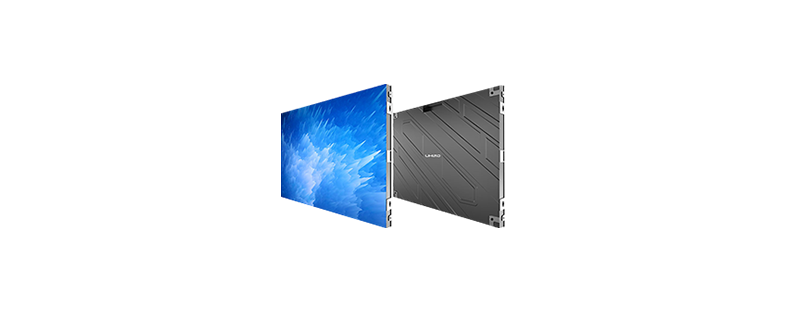
Les options de pas de pixel fin pour intérieur de UHLED incluent P1.25, P1.538, P1.86, P2 et P2.5. Pour sa gamme de boîtiers en aluminium moulé sous pression pour intérieur, le modèle P1.538 offre une luminosité de 600 cd/m², adaptée à de nombreuses conditions d'éclairage intérieur sans être agressive. Son taux de rafraîchissement de 3840 Hz est également un atout pour les caméras, les visioconférences ou le contenu en direct. Pour les acheteurs comparant… écran LED intérieurCes chiffres répondent à des questions très concrètes concernant la clarté, le confort et la qualité du contenu.
Comment le mur vidéo LED intérieur a-t-il transformé l'espace ?
Le résultat de ce projet ne se limite pas à un mur plus lumineux ; il transforme la fonctionnalité de la pièce. Un mur d'images LED intérieur de haute qualité peut devenir le point focal visuel d'un espace, notamment lorsqu'il remplace des écrans séparés, des projecteurs ou d'anciens systèmes d'affichage. Plus la pièce est utilisée, plus ce changement est bénéfique.
Un affichage intérieur sans faille avec un contenu quotidien plus net
Après la mise à niveau, le mur d'écrans LED haute résolution a permis d'afficher des diapositives de présentation plus nettes, une lecture vidéo plus fluide et une identité visuelle plus percutante. L'affichage intérieur continu a également éliminé les ruptures visuelles souvent présentes sur les systèmes LCD multi-écrans. Ceci s'avère particulièrement utile pour l'affichage d'images de grande taille, de tableaux de bord de données ou d'arrière-plans vidéo.
Ce type de solution d'affichage intérieur est utile car le contenu est rarement simple. Un jour, vous aurez peut-être besoin d'un graphique financier. Le lendemain, d'une démonstration de produit, d'une réunion à distance ou d'une vidéo de formation. La norme P1.538 permet à l'écran de gérer ces tâches variées avec un minimum de compromis. Ce n'est pas de la magie, mais simplement une meilleure adéquation entre la qualité d'affichage et l'utilisation réelle de la pièce.
Qu’est-ce qui a rendu l’installation d’écrans LED pratique pour les acheteurs B2B ?
Un bon écran peut se révéler un mauvais projet si son installation et sa maintenance sont difficiles. Les espaces intérieurs présentent souvent des contraintes telles que des murs étroits, un espace arrière limité, des finitions intérieures et des délais serrés qui laissent peu de place aux retouches. C'est pourquoi la structure derrière l'image est aussi importante que l'image elle-même.
Maintenance en façade : réduction de la pression à long terme
Le boîtier intérieur en aluminium moulé sous pression d'UHLED utilise un aimant entretien du service avantAinsi, un module peut être retiré par l'avant. Pour une installation murale intérieure fixe, c'est un avantage pratique. L'entretien courant ne nécessite ni un accès arrière profond ni un démontage important.
Les dimensions des armoires (640 × 480 × 65 mm) et des modules (320 × 160 mm) permettent une installation compacte des écrans LED. L'aluminium moulé sous pression assure robustesse, alignement précis et dissipation thermique. UHLED, fabricant d'écrans LED basé à Shenzhen et fondé en 2015, propose une gamme de produits couvrant l'éclairage intérieur et extérieur, la location, la signalétique commerciale, les écrans d'affichage, les écrans cubiques, les films LED flexibles et les solutions d'affichage LED transparentes. Son usine de production s'étend sur environ 5 000 mètres carrés et affiche une capacité de production annuelle de 120 000 mètres carrés. Elle offre une garantie de 5 ans et possède plus de 40 certifications et brevets d'invention. Pour les acheteurs B2B, ces atouts sont indéniables. UHLED Bien plus qu'un fournisseur de produits, c'est un véritable partenaire de projet pour la planification, la production et le soutien à long terme.
Quelles leçons peuvent tirer des projets d'affichage intérieur commerciaux similaires ?
Ce projet nord-américain démontre que le choix d'un écran d'intérieur commercial doit se faire en fonction de son utilisation réelle, et non uniquement en fonction du prix ou de la taille de la diagonale. Lorsque les utilisateurs sont assis près l'écran, un problème de pixellisation devient rapidement visible. Lorsque le contenu change quotidiennement, la résolution et la planification du signal sont essentielles. Enfin, un mur fixe facilite la maintenance et évite les problèmes ultérieurs.
Le principal résultat a été la confiance.
Grâce à la technologie LED à petit pas P1.538, l'espace a bénéficié d'une surface d'affichage plus nette, d'une qualité d'image plus claire et d'une esthétique plus moderne. Plus important encore, le client disposait d'un écran parfaitement adapté à ses besoins de communication quotidiens. C'est sur ce point que les acheteurs B2B devraient se concentrer. Un écran n'est pas acheté pour le devis, mais pour les personnes qui l'utiliseront chaque jour.
Pour une salle d'exposition, une salle de conférence, un centre de formation ou un espace d'accueil haut de gamme, un écran LED à pas de pixel fin améliore la lisibilité des informations et modernise l'ensemble de l'espace. Si vous envisagez une rénovation similaire en intérieur, consulter la gamme d'écrans LED UHLED est un excellent point de départ pour trouver le pas de pixel, le design du boîtier et les caractéristiques adaptés à vos besoins.
FAQ (questions fréquentes)
Q1 : Qu'est-ce qui rend le P1.538 adapté aux espaces intérieurs nécessitant une vision rapprochée ?
A : La résolution P1.538 possède un faible pas de pixel, ce qui garantit une meilleure netteté des images, des textes et des graphiques pour les spectateurs assis près de l'écran. Elle est idéale pour les salles de réunion, les showrooms et autres espaces intérieurs où la distance de visionnage est souvent courte.
Q2 : La technologie LED à petit pas P1.538 est-elle meilleure que les murs vidéo LCD ?
R : Pour de nombreux projets d'aménagement intérieur, oui. Il offre une surface d'affichage uniforme, des dimensions flexibles, une image très détaillée et aucune séparation visible entre les panneaux. Les murs d'écrans LCD peuvent encore convenir dans certains cas, mais les joints peuvent nuire à la qualité visuelle des contenus haut de gamme.
Q3 : Pourquoi la maintenance en première ligne est-elle importante ?
A : Maintenance en façade Permet l'entretien des modules par l'avant de l'écran. Ceci est particulièrement utile lorsque l'écran est installé contre un mur ou dans un espace où l'accès par l'arrière est limité.
Q4 : Quel type de contenu fonctionne bien sur un mur vidéo LED intérieur ?
A: Les présentations, les vidéos de produits, les tableaux de bord de données, les réunions vidéo, les visuels de marque, le contenu de formation et les arrière-plans d'événements fonctionnent tous bien lorsque la résolution d'écran et le rapport contenu-image sont correctement planifiés.
Q5 : Que devez-vous vérifier avant de démarrer un projet d’écran LED intérieur en Amérique du Nord ?
A : Vérifiez la distance de visionnage, l'éclairage de la pièce, la taille de l'écran, le pas de pixel, la résolution réelle, la structure du boîtier, l'accessibilité pour la maintenance, la méthode d'installation et le support du fournisseur. Ces points influent sur la qualité d'image finale et la durabilité de l'appareil.


